
The concept of moving mountains is a powerful metaphor in Christian faith, symbolizing the sheer might of true belief and the possibilities that open up when one has absolute trust in God. Found in several key passages within the Bible, this metaphor encapsulates the idea that faith, even as small as a mustard seed, can overcome enormous challenges. The phrase is often credited to Jesus, who used it to teach his disciples about the potency and potential of unwavering faith.

As we explore various bible verses about moving mountains, we discover the depth and nuances of faith and its application in our lives. These scriptures encourage believers to examine the strength of their faith and to understand doubt’s role in their spiritual journey. They also offer guidance on how to exercise faith in practical ways, reminding us that our beliefs can significantly impact our actions and the world around us.
Key Takeaways
- Biblical teachings highlight the transformative power of faith in God’s presence.
- Jesus’s words illustrate faith’s ability to overcome the metaphorical mountains we face.
- Embracing faith entails trusting in God’s promises and applying them in daily life.
Scriptural Foundations of Mountain-Moving Faith
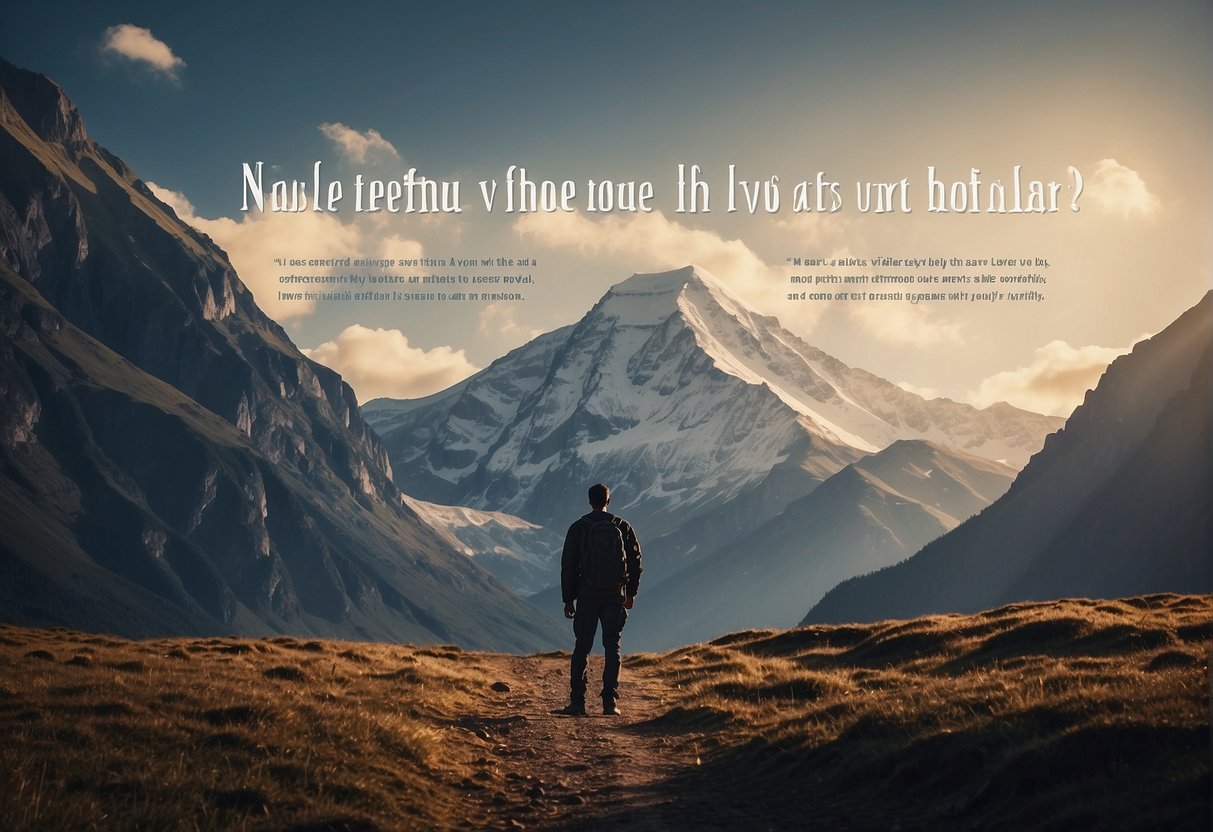
Scripture is replete with passages that empower us with the understanding that faith has the potential to metaphorically ‘move mountains.’ From the poetic books of the Old Testament to the instructive epistles of the New Testament, the Bible offers us foundational insights into the nature of faith as a force for transformation and miraculous actions.
Old Testament References
In the Old Testament, mountains often symbolize large and immovable challenges. However, passages like Isaiah 40:4 (“Every valley shall be raised up, every mountain and hill made low”) capture the essence that through faith, and God’s intervention, what seems unalterable can be overcome. The Psalms, too, echo this sentiment; Psalm 46:2 asserts, “Though the mountains be moved into the heart of the sea, we will not fear,” highlighting an unwavering faith in God’s protective power.
New Testament Insights
The New Testament further develops this concept. For instance, faith is likened to a seed in Luke 17:6, “If you have faith as small as a mustard seed, you can say to this mountain, ‘Move from here to there,’ and it will move.” This amplifies the Old Testament metaphors and applies them to the individual’s belief in God.
The Gospels and Acts of Faith
The Gospels present several instances where Jesus speaks directly about the power of faith. In Matthew 17:20, Jesus responds to the disciples’ inability to perform a miracle by saying, “If you have faith as small as a mustard seed, you can say to this mountain, ‘Move from here to there,’ and it will move.” Similarly, Mark 11:23 emphasizes the same, condensing the profound ability of faith to alter reality.
Epistles: Faith and Love in Action
Paul provides further exposition on faith in his epistles. In 1 Corinthians 13:2, it is said, “If I have a faith that can move mountains, but do not have love, I am nothing.” This embeds the principle that faith operates not in isolation but in conjunction with love—both principles are essential in the life of a believer.
Faith in Prophecy
Lastly, prophecy in Scripture frequently interlinks faith with eschatological promises. The book of Revelation speaks of a new creation where former things, such as death and pain, are passed away (Revelation 21:1-4), requiring a faith that looks to the ultimate “moving” of the old order to make way for the new. The idea of the “covenant of peace” mentioned in prophets like Nahum also leans on faith in God’s future act of restoration, symbolically “moving mountains” of conflict and despair.
Understanding Faith and Doubt

As we explore biblical scriptures, we find that the relationship between faith and doubt is central to our understanding of what it means to truly believe. These concepts are not just abstract notions; they are intertwined in our everyday walk with God and reflected in specific passages such as Matthew 17:20 and Mark 11:23.
Mustard Seed Faith
According to Matthew 17:20, even a faith as small as a mustard seed has the potential to do the impossible. When we say “mustard seed faith,” it’s a metaphor for the immense potential of even a tiny amount of unwavering faith in God.
Faith Without Doubt
Mark 11:23 encourages us to have faith that does not falter. This means that when we speak or pray, we are to do so with full confidence, without a hint of doubt in our hearts. To have faith without doubt, is to believe that our prayers and words will manifest even when outcomes seem unlikely.
Faith and Wavering
Our human experience is often marked by wavering; James talks about the one who doubts being like a wave of the sea, blown and tossed by the wind. To stabilize our faith, we must turn to the teachings of Jesus, remembering that it’s in Him we find help to overcome our uncertainty and sustain a steadfast spirit.
Practical Aspects of Faith

When we approach the concept of faith moving mountains, we understand it not just as a poetic expression but as a deeply practical aspect of our spiritual walk. It guides us in how our faith should result in transformative actions and attitudinal shifts.
Prayer and Moving Mountains
Prayer is foundational to our faith, acting as the medium through which we communicate with the Divine. In Matthew 17:20, Jesus asserts that faith as small as a mustard seed can move mountains. When we pray with unwavering conviction, we are essentially speaking to the mountain peaks of challenges in our lives, expecting God to act. Prayer intertwined with faith brings about the impossible, moving from just the plain into the extraordinary.
Works and Faith
James 2:17 emphasizes that faith without works is dead. It’s not enough for us to pray for a mountain to move; our actions must demonstrate our belief. When we extend compassion to others or actively work to improve a situation, we embody the practical outworking of our faith. Whether it’s in a valley of despair or on a busy plain of life, our deeds become the testimony of an active and living faith, bridging the gap between the spiritual and the tangible.
The Role of Love
As we explore moving mountains through faith, we cannot overlook 1 Corinthians 13:2, where love is held as the greatest of all virtues. Without love, our faith and our efforts are rendered void. Love infuses grace into our actions, ensuring our works are not just duties, but reflective of Christ-like compassion. It’s love that sustains and amplifies the power of faith, moving us to act selflessly and with purpose, just as mountain peaks stand firm through storms.
Mountains as Metaphors

In scriptural language, mountains are often symbolic, representing significant challenges or seemingly insurmountable obstacles. We see these powerful images as illustrations of personal triumphs and the steadfastness of faith.
Challenges and Triumphs
When we talk about moving mountains, it’s an expression of our ability to handle the challenges before us, no matter how massive they may seem. The phrase is rooted in Biblical verses which suggest that faith, even as small as a mustard seed, can accomplish what appears to be impossible. For example, a well-known passage in Mark 11:23, as seen on OpenBible.info, highlights the prodigious power of unwavering belief and the spoken word.
Obstacles in Life and Faith
Equating obstacles in life to a mountain captures the essence of struggles we encounter, and the term can be extended to any hill or valley we face. The scriptures utilize these metaphors to communicate that faith is not just belief in the absence of knowledge, but a profound knowledge that with divine help, what seems impossible becomes possible. The crux of this concept is exemplified in Matthew 17:20, which you can read more about at Bible Study Tools, where it signifies that faith can figuratively move mountains from here to there. It underscores a transformative power that starts within the heart and extends far beyond, even into the sea of life’s tumultuous circumstances.
The Christian Life and Moving Mountains

The concept of “moving mountains” in the Christian life is a metaphor for the seemingly impossible feat being realized through steadfast faith and trust in God’s power. This section explores the practical aspects of such faith within personal and communal Christian experiences, its miraculous nature, and the eternal outlook that frames our understanding of these scriptural teachings.
Living Faith in Community
Within the church, we understand that love and truth are the foundations upon which the community of believers is built. This community support strengthens our faith, as promised in Matthew 17:20, manifesting as a shared belief that can “move mountains.” By providing encouragement and affirming the good news of salvation together, we mirror the intended unity of disciples within Zion, creating an interdependent network that upholds one another in all of life’s challenges.
Individuals and Miraculous Faith
As individuals, we hold the personal responsibility to nurture a faith that can see the miraculous occur, much like the fig tree that Jesus spoke of. When our faith is as small as a mustard seed, we embody the authority Jesus imparted to us to command the mountains of our lives—be it a difficult job or a humanitarian crisis among peoples or in Judah. Our individual acts of faith resonate with our communal beliefs, reinforcing the notion that with God, nothing is beyond our reach.
Eternal Perspectives
Keeping an eternal perspective reminds us that our journey doesn’t end at death but continues towards eternal life and heaven. Salvation, a fundamental aspect of our faith, encompasses not only our current life but also our eternal destiny. Recognizing that earthly obstacles, like towering mountains, are transient compared to the glory of heaven helps us maintain a focus that surpasses our temporal existence. It is in this light that we cast our eyes upon the ultimate truth that our faith, no matter how minute, aligns us with the divine plan of salvation.